Northern Lights
Northern Lights in Finland: Best Times to See Them — and Avoid Light Pollution
When are the best months to see the Northern Lights in Finland? A practical calendar, honest expectations, and advice on finding dark skies away from light pollution.
8 min readRoadTripFinland
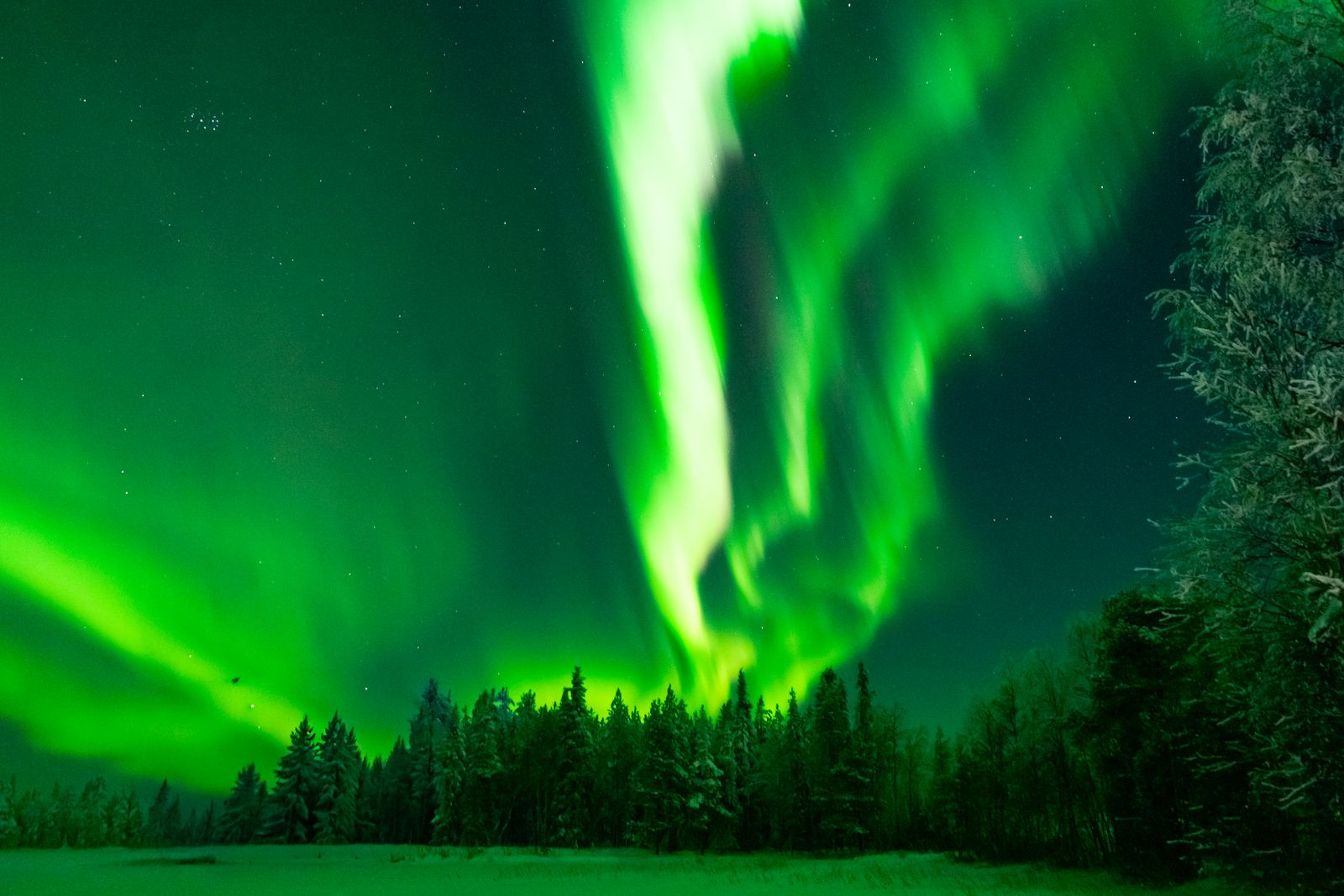
The Northern Lights are one of the most sought-after experiences in Finnish Lapland. They are also one of the most misunderstood.
No calendar, no tour operator and no travel article can guarantee you will see them. What a good guide can do is explain when the conditions are most likely to align — and what you can do to improve your chances.
Northern Lights Calendar for Finland
This calendar describes seasonal conditions, not probabilities. The Northern Lights cannot be predicted for a specific night.
| Month | Darkness | Useful viewing hours | Seasonal usefulness | RoadTripFinland take |
|---|---|---|---|---|
| September | Increasing; equinox brings long dark periods | Several hours of genuine darkness | Early season; snow unlikely in south | Worth trying in Lapland; unpredictable weather |
| October | Good darkness returning | 4–6 hours of dark sky | Reasonable; snow possible in north | Underrated month; fewer crowds |
| November | Long nights, especially in north | 6–8+ hours | Good darkness; cloud cover common | Quiet season; commit to several nights |
| December | Maximum darkness in far north | Many hours; polar night in far north | Peak darkness but peak demand and cloud | Book early; manage expectations |
| January | Still very dark | Long dark periods | Good conditions if skies clear | Often cold and clear; good month |
| February | Increasing daylight but still dark | 4–6 hours | Good balance of darkness and daylight | Favourite month for many visitors |
| March | Daylight returning; equinox | 3–5 hours | Decreasing but still possible | Snow often still good; milder temperatures |
| April | Too much daylight in south; possible in far north | Limited | Marginal except far north | Not reliable for most visitors |
Important: This calendar cannot predict an individual night. A clear, dark night in October can produce a spectacular display. A cloudy December night in Lapland produces nothing. The calendar describes when the conditions for viewing are most likely to be present — not when you will see the lights.
The Four Factors That Must Align
Seeing the Northern Lights requires four things to happen at the same time:
1. Sufficient solar activity. The Aurora is caused by charged particles from the sun interacting with Earth's atmosphere. Solar activity varies and cannot be predicted more than a day or two in advance. The Kp index is the most commonly used measure — a higher Kp means the Aurora is visible farther south. Check the Finnish Meteorological Institute's space weather service (avaruassaa.fi) or the NOAA Space Weather Prediction Center (swpc.noaa.gov) for current forecasts.
2. Darkness. The Aurora is always there when solar activity is sufficient, but you can only see it in darkness. In Finnish Lapland, the darkest months are November through February. In southern Finland, summer nights are too bright for Aurora viewing.
3. Clear skies. Cloud cover blocks the view entirely. This is the factor that disappoints the most visitors. Finland's winter skies can be cloudy for days at a time. Check cloud cover forecasts separately from Aurora activity forecasts — both must be favourable.
4. Low light pollution. The Aurora is visible from cities when it is very strong, but a moderate display can be washed out by street lighting. Moving away from town — even a few kilometres — makes a significant difference.
How to Combine Aurora Activity and Cloud Forecasts
A worked example of how to check conditions:
- Check the Aurora forecast: avaruassaa.fi (Finnish Meteorological Institute) or swpc.noaa.gov (NOAA). Look at the Kp index forecast for the next 24–48 hours.
- Check the cloud cover forecast: fmi.fi (Finnish Meteorological Institute weather forecast). Look at cloud cover for your specific location, not just the nearest city.
- If both show favourable conditions — reasonable Kp and clear or partly clear skies — it is worth going out.
- If cloud cover is forecast to be heavy, even a strong Aurora forecast is unlikely to produce a visible display.
Do not rely on a single app that combines both forecasts without showing you the underlying data. Understanding what each number means gives you better judgement about when to go out.
Finding Dark Skies: Avoiding Light Pollution
Light pollution is a real factor. A display that would be spectacular in a dark rural area can be barely visible from a town centre.
Practical ways to find darker skies:
- Drive or walk a few kilometres away from town lighting
- Look for open areas — a frozen lake, a fell top, an open field — rather than forest (trees block the horizon)
- Check that you have permission to be in the area and a safe route back
- Never stop on a road shoulder to watch the sky — use a proper parking area or a designated viewpoint
A cabin outside a town centre can give you immediate access to darker skies without needing to drive at night. Many cabins in Finnish Lapland are in areas with limited nearby lighting.
Many cabins can have darker surroundings depending on their location — but this is not guaranteed. Check the cabin's location relative to nearby towns and lighting before booking specifically for Aurora viewing.
Browse Finnish cabins on Lomarengas — use the search to filter by area. Confirm the location and surroundings before booking if dark skies are a priority.
Ad link: Lomarengas. We may earn a commission if you book through this link, at no extra cost to you. Opens in a new tab. Read more.
Lapland vs Southern Finland
Finnish Lapland generally offers more frequent opportunities because it is farther north and has many dark areas. Southern Finland can still see strong displays during high solar activity, but it is less reliable for a short trip built around the Aurora.
Choose your destination for the whole holiday, then treat the lights as one part of it. A trip to Lapland that you enjoy in cloud, snow and daylight is a good trip. A trip built entirely around one clear night is a gamble.
Are Guided Aurora Tours Worth It?
A guided tour can be worth paying for if you do not have a car, want help reading conditions or prefer someone else to manage night travel. It cannot control clouds or solar activity.
Before booking, compare: group size, how far the operator actually travels to find dark skies, cancellation terms if conditions are poor, and what the experience includes beyond the Aurora itself.
A car gives you the flexibility to move when conditions change — to drive away from cloud cover, to find a darker spot, to go out at 2am when the forecast improves. That flexibility is one of the genuine advantages of self-drive travel for Aurora hunting.
Compare rental cars in Finland on DiscoverCars — check winter-equipment terms and pickup location before booking.
Ad link: DiscoverCars. We may earn a commission at no extra cost to you. Opens in a new tab. Read more.
If you are driving at night to find dark skies, read the winter driving guide first. Never stop on an unlit road shoulder.
The Most Practical Aurora Strategy
Give yourself multiple evenings. Keep evenings flexible. Check both cloud cover and Aurora activity each afternoon. Be willing to go out at unusual hours when the forecast improves.
A three-night stay with one clear night is a realistic outcome in Finnish Lapland during the core winter season. A one-night stay with a guaranteed display is not a realistic expectation.
FAQ
Can you see the Northern Lights from Rovaniemi? Yes, conditions can be good outside the brightest parts of the city. Moving a few kilometres from the centre makes a significant difference.
Which Lapland base is best for Aurora viewing? Any base that gives you access to dark surroundings. A cabin outside a town centre is often better than a central hotel. Compare options in Where to Stay in Lapland.
Is it safe to drive out to see the Aurora? Only if you are comfortable with winter driving and have checked road conditions. Read the winter driving guide first. Never stop on a road shoulder.
What is the Kp index? A measure of geomagnetic activity. A higher Kp means the Aurora is visible farther south. Kp 3–4 is typically needed for a visible display in Finnish Lapland; Kp 5+ can produce displays in southern Finland. Check current forecasts at avaruassaa.fi or swpc.noaa.gov.
Can the Northern Lights be predicted? Solar activity can be forecast 1–3 days ahead with reasonable accuracy. Cloud cover can be forecast a few days ahead. Beyond that, both become uncertain. No one can reliably predict a specific night weeks in advance.
Related reading: Where to Stay in Lapland · Finnish Lapland in Winter: 10 Places Worth the Drive · Finland in Winter: 10 Things That Surprise First-Time Visitors · Finnish cabin holidays · Driving in Finland in Winter
Topics
Continue planning